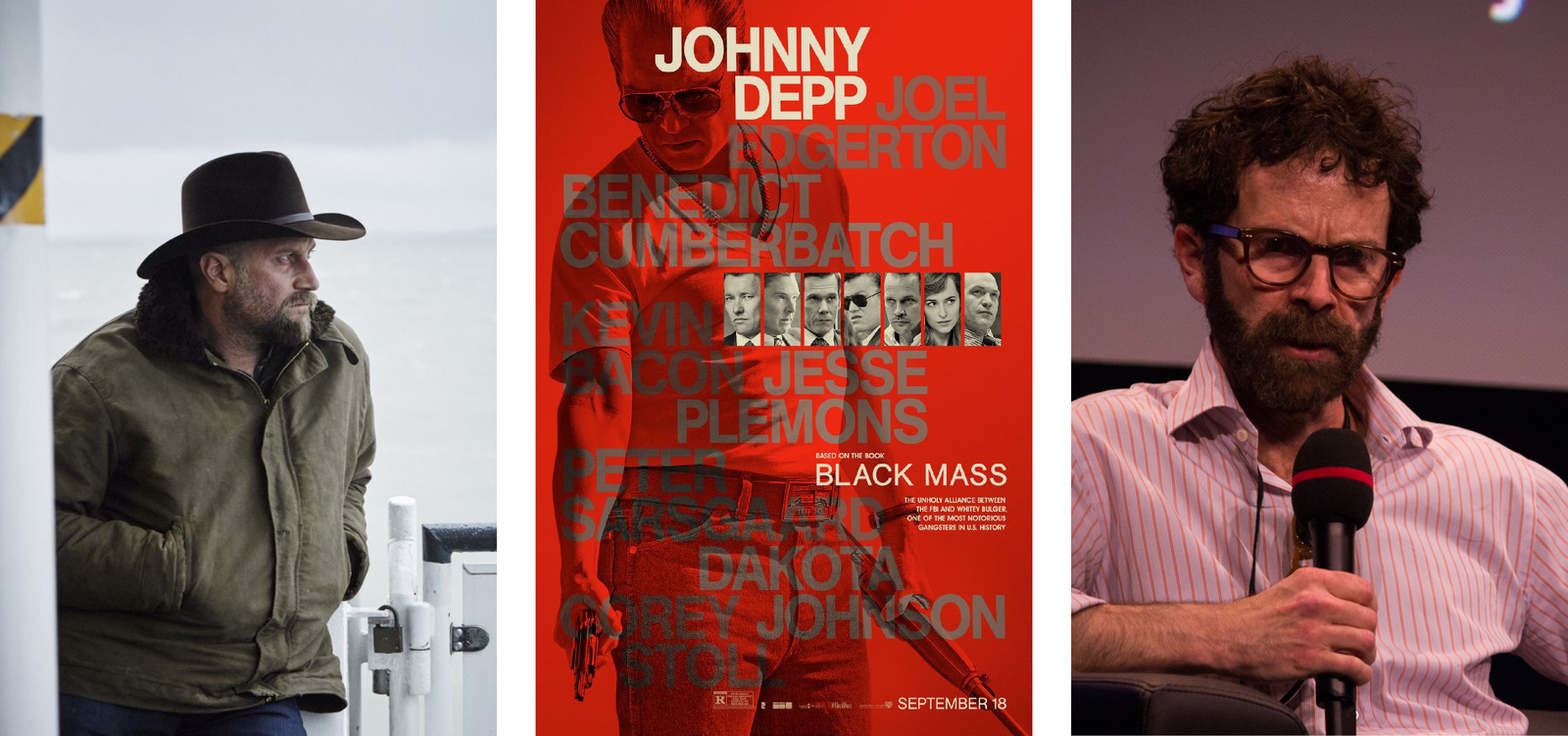
Les Cowboys
The first film I saw in the Toronto International Film Festival ended up being tied for my favorite film of the festival. Thomas Bidegain’s directorial debut, Les Cowboys, stunned me in every way. Les Cowboys is a modern French adaptation of John Ford’s 1956 classic The Searchers. Having not seen The Searchers, I did not view Les Cowboys as an adaptation, nor will I review it as such. Rather, I was very easily able to distinguish the film as its own entity and story, as it very clearly set its own tone and did not feel like it was borrowing from previous work.
Les Cowboys follows Alain, the father of a teenage girl, Kelly, who runs away with her Middle Eastern boyfriend. After police prove to be no help, Alain takes matters into his own hands and searches for his daughter for half a decade. As he fearlessly devotes all his time to finding his daughter and never gives up hope, his brings his son along to help.
As his son, Georges, grows older, he becomes more and more reluctant to fuel his father’s hopes by joining him in his searches. Eventually, Georges refuses to search with his father. After their falling-out, Alain tragically dies in a car accident.
After his father’s death, Georges decides to pick up where his father left off, and continue the search for his sister. After over half a decade, it proves difficult to find fresh leads. However, his persistence pays off through very dangerous situations. He meets Kelly’s ex-boyfriend, and in a misunderstanding that turns into a heated argument, Georges shoots and kills her ex-boyfriend. When he is finally out of trouble, he loses some motivation, but gives it one last try. Georges finds Kelly working at a convenience store. Their eyes meet, and they acknowledge each other’s existence, but they do not speak. As an audience, we are left without closure in regards to their relationship.
In addition to the complex story that surprises viewers and does not conform to structural norms, the visuals in the film were quite stunning. The use of (likely vintage) anamorphic lenses created a sort of blurred vignette throughout the film, giving it a very unique feel. This put emphasis on the characters, which was important, given the complex development of multiple characters throughout the story. The color palette of the film was quite dark and muted, which matches the tone of the story.
Overall, this film is a huge success for first-time director Thomas Bidegain. He tied together this story in multiple complex ways that are often not found even in experienced directors’ films. Reflecting on Les Cowboys makes me sad that it is very likely this film will not be distributed past France, and I may not be able to share this film with others. However, with the success and growth of streaming services in the past few years, perhaps Les Cowboys will eventually stream online. For now, I will simply wait for a sophomore film from Bidegain.
Black Mass
Though I knew I could wait just a few extra days and see Black Mass once we returned home, I couldn’t stand the wait. Scott Cooper’s third directorial credit couldn’t be more worth the watch. Black Mass follows the true story of James ‘Whitey’ Bulger, one of the most infamous American criminals of the 20th century. Whitey Bulger was incredibly feared, but respected across all of Boston in the 1970s. After reuniting with a childhood friend, now an FBI agent, Whitey is given a proposition to form a partnership with the FBI. Although Whitey is apprehensive at first, afraid of being hypocritical as he was known for beating and killing ‘rats,’ his trust in his childhood friend John Connolly gives him enough confidence to agree to the deal. Whitey becomes an informant for the FBI in exchange for help in taking down a rival mafia family and an unspoken contract between Whitey and the FBI that allows Whitey’s crew to operate largely unbothered.
The story is told quite accurately, to the best of my knowledge. But, it does not feel like a biography. I feel that Cooper captured the entire story quite well without placing too much prominence on one character or event. Whitey was certainly the main draw of the story, but we learn enough about other characters so it doesn’t feel one-sided.
Cooper had the advantage of working with an incredibly talented all-star cast. Johnny Depp perfectly captured Whitey Bulger, to the point that it does not even seem like it is Johnny Depp. Alongside Depp, Joel Edgerton as John Connolly and Benedict Cumberbatch as Whitey’s brother and state senator Billy Bulger bring stunning performances to the film’s acting department. Dakota Johnson, Kevin Bacon, Adam Scott, Peter Sarsgaard, and many others also complete the incredible cast.
A point of interest in terms of cast is the lack of female screen time. However, I don’t think this was done distastefully. I think with both the time period and the subject matter, it is fitting that there is a lack of female presence. Overall, though I might like to see more screen time for the female characters in the film, I was not too disappointed by this decision.
Overall, Black Mass makes me very excited for what is to come from relatively new director Scott Cooper. Cooper has started to create a directorial signature with only three films. I have not seen Crazy Heart as of yet, so I will not speak to that film. However, both Out of the Furnace and Black Mass deal with crime, violence, and vengeance in a very unique way. They are used by the protagonists in ways that do not compromise the relatability of the characters despite their unrelatable actions. Both films also deal with very dark stories that do not end completely resolved. This is definitely my type of film, and I can’t wait to see what Cooper does next.
Not to mention, I’m a sucker for some artistic use of anamorphic lenses.
Indiewire with Charlie Kaufman
On Monday, September 14, Indiewire held their panel discussion with Charlie Kaufman, Duke Johnson, and Rosa Tran regarding their new film, Anomalisa. This discussion was probably my most-anticipated event of the entire festival. And it did not disappoint. The interviewer, however, did.
With the rare opportunity to interview the esteemed Charlie Kaufman, the greatest screenwriter of our time, you would assume the interviewer would prepare some kick-ass questions and listen very carefully in an effort to build off Charlie’s incredibly thoughtful answers to create equally thoughtful questions. This is how discussions work; they are two-way conversations. This is not what I witnessed.
The interviewer/moderator tiptoed his way into topics that Charlie clearly did not want to talk about, and should feel fortunate to have received such thoughtful answers to thoughtless questions. He then went on to basically insult Charlie, asking for Charlie to explain his lack of work in the past years. I don’t know what answer the interviewer expected, but even the audience felt uncomfortable listening to Charlie rhetorically wonder why nobody has funded his scripts in the recent years. Overall, I was disappointed in the way the interviewer presented topics and jumped between questions without tying topics together. But, this made it all the more impressive to hear Charlie Kaufman find thoughtful and insightful ways to answer underwhelming and sometimes insulting questions.
Fortunately, I still pulled a lot of information from Charlie Kaufman’s answers. First, it was very interesting to hear the story behind the conception of the idea. Anomalisa started as a soundplay that was performed successfully ten years ago. The format of a soundplay lent the idea of drawing attention to the fact that there are only a few voice actors. Charlie used this idea to create a world in which one voice actor played every part but two.
The stop-motion aspect was brought to him, rather than him first deciding on that format. This was very interesting to me, as I thought such a major element of the film would have to be determined as the best way to display the screenplay in a visual manner. However, it ended up making the most sense as a format. Many elements of the script are designed not to be seen, since it was first written as a soundplay. So, it would be difficult to show some elements with live action. In the same way, the contradiction between the audio and visuals (female characters voiced by a man, the same man voicing all but two parts) is something that could only be done with an animated film.
At the end of the discussion, I was fortunate enough to ask the last audience question before the event ended. Charlie Kaufman gave me an incredibly insightful answer that will stick with me as great advice. He spoke of the way the film industry does not necessarily promote quality content. Producers play it safe by making films that are sure to be successful. Audiences will pay money for surface-level Hollywood blockbusters, making such blockbusters the safest route for financiers.
However, Charlie Kaufman ignores the way the industry works and continues to take risks in his scriptwriting in order to feed audiences substantial content. Although it has made it harder for him to find funding for his films, he finds it more important to create quality content. This really inspires me to continue taking the untraditional path and to only make the films I feel are important. I want to set precedents, not follow them.
Anomalisa was picked up by Paramount for global distribution just two days after this panel discussion took place. There is hope after all.